

Your Pathway to a Career in AT
A Guide for Students and Professionals
Feb 16, 2026
Imagine a career where engineering meets human health — specifically, enhancing the lives of individuals with disabilities through innovative Assistive Technology (AT). The Graduate Certificate in Assistive Technology and Inclusive Engineering at the University of Colorado Denver equips you with the skills to create solutions that restore function, support independence, and improve lives.
There is no single road into this field. Below are two pathways — one designed for students building toward a career in biomedical engineering, and one for working professionals ready to deepen or formalize their expertise in assistive technology.
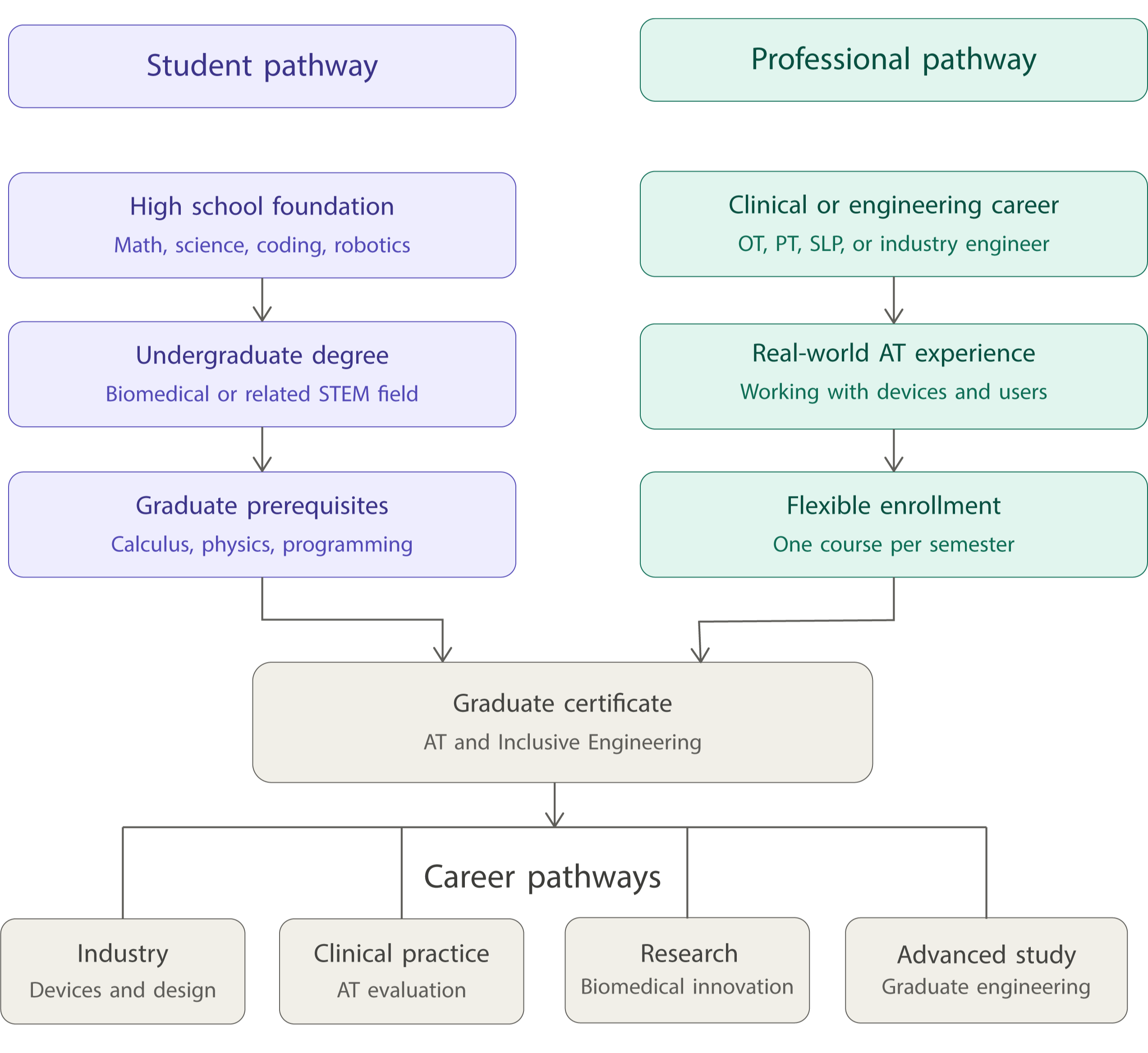 View graphic description
Path 1: For Students — From High School to Graduate Certificate
Step 1: Build a Strong Foundation in High School
High school is your launchpad into assistive technology. Focus on courses that develop analytical thinking and problem-solving skills:
- 📐 Math: Algebra → Geometry → Pre-Calculus → Calculus
- 🧪 Science: Biology and Chemistry → Physics
- 💻 Technology: Computer science or coding (if available)
- 🚀 Extracurriculars: Robotics, engineering clubs, science fairs
These foundational skills are essential for future biomedical engineers, especially those focused on developing assistive technologies.
Step 2: Choose the Right Undergraduate Path
Option A — Biomedical Engineering Bachelor's Degree
Earn a Bachelor of Science in Biomedical Engineering, focusing on curricula that prepare you for graduate studies in assistive technology. At CU Denver, you'll gain the technical skills and critical thinking necessary for designing innovative AT solutions.
Option B — Related STEM Degree
If you pursue a related major — mechanical, electrical, chemical, or biological engineering — ensure you complete key prerequisite courses:
- Calculus I, II, Differential Equations / Linear Algebra
- One year of college-level Physics (calculus-based preferred)
- Computer science or programming experience recommended
Step 3: Pursue the Graduate Certificate
Once you complete your undergraduate degree, enroll in the Graduate Certificate in Assistive Technology and Inclusive Engineering at CU Denver. The program covers critical areas including:
- Assistive and Rehabilitation Technologies
- Medical Device Design & Regulatory Affairs
- User-Centered Design for Accessibility
The certificate is designed to be completed flexibly, allowing students to take one, two, or three courses per semester while managing other commitments.
Path 2: For Working Professionals — Deepen Your Expertise in AT
If you are already working in a clinical or engineering field, the Graduate Certificate in Assistive Technology and Inclusive Engineering offers a powerful opportunity to expand your impact without stepping away from your career.
Clinicians — including occupational therapists, physical therapists, and speech-language pathologists — bring invaluable real-world knowledge to this program. So do engineers working in healthcare, rehabilitation, or product development. The certificate builds on what you already know, adding technical depth, design methodology, and hands-on experience with the latest AT tools and technologies.
Skyler, a neurodiagnostic technician and one of the first students to complete the certificate program, came to the program with years of healthcare experience and a lifelong connection to the disability community. “Working in healthcare, you see great technology that nobody can actually use — somewhere along the way, nobody stopped to ask if it was going to work for real people. That’s what this program teaches you to do.”
Because the program is deliberately hands-on, it is not offered online. Students engage directly with devices, users, and clinical environments — the kind of learning that can’t happen on a screen. Working professionals may complete one course per semester, building expertise steadily without disrupting their careers or their lives outside of work.
For clinicians already recommending or prescribing AT, the certificate provides the engineering and design foundation to understand why certain solutions work, evaluate new technologies more critically, and collaborate more effectively with engineering teams. For engineers, it offers direct exposure to clinical practice and the lived experience of AT users — closing the gap between what gets built and what people actually need.
Beyond the Certificate — Where These Paths Lead
Whether you arrive as a student or a seasoned professional, the Graduate Certificate in Assistive Technology and Inclusive Engineering opens doors across a range of meaningful careers:
- Industry & Innovation: Design and develop assistive devices that enhance mobility, communication, and independence
- Clinical Practice: Bring deeper technical fluency to AT evaluation, recommendation, and implementation
- Biomedical Research: Contribute to research that improves AT solutions for diverse populations
- Advanced Study & Academia: Pursue graduate engineering programs or lead the next generation of AT innovators
Why CU Denver’s Program?
- Hands-on, real-world learning: Work directly with clinicians, engineers, and AT users in state-of-the-art facilities on the CU Anschutz Medical Campus
- Flexible pacing: Take one, two, or three course per semester and build expertise at a pace that works for your life
- A collaborative medical campus: Engage with researchers, clinicians, and innovators across one of the region’s leading academic medical centers
- Designed with people in mind: Every course, every project, and every clinical experience is grounded in the principle that the best AT solutions are built with the people who use them
Author: Elizabeth Coughanour
Take the Next Step
The Center for Inclusive Design and Engineering (CIDE) at CU Denver advances assistive technology through innovative research, academic programs, and industry partnerships.
Join us in advancing assistive technology! Explore the Graduate Certificate in Assistive Technology and Inclusive Engineering at CU Denver and become a catalyst for change in the lives of individuals with disabilities. Learn more about the program here.
Contact Jackie McBride at [email protected] to learn more about the Graduate Certificate in Assistive Technology and Inclusive Engineering.