Turning Professional Drive Into Academic Success
How Omar Mendoza is Rebuilding His Path Through Science, Support, and Purpose with CU Denver
Yining Wang | Office of Advancement Feb 20, 2026
On most afternoons, Omar Mendoza moves easily between classrooms, labs, and study spaces across the CU Denver campus. He speaks comfortably with classmates and faculty, shifts between Spanish and English without hesitation, and carries himself with a confidence shaped by experience. Few would guess that only two years ago, his days were spent in restaurant kitchens, measured by prep lists and dinner rushes.
A Life Built in Kitchens
Like many students on our campus, Omar did not arrive at CU Denver through a traditional path. His journey spans professional kitchens, business risk, academic reinvention, and a growing commitment to educational access as a first-generation college student. “Coming back to school after a decade in the restaurant industry changes your perspective. I’m not here to just get a grade; I am here because I have seen the ‘real world’ and I want to better my life by making a deliberate choice to get a proper education,” Omar said. “CU Denver is a perfect choice because I don’t feel like an outlier anymore. There is a respect here for the experience you bring from your previous life, and the university provides the structure you need to turn that professional drive into academic success.”
After graduating from high school in Texas, Omar enrolled in culinary school and committed himself fully to becoming a chef. Cooking had been an interest since childhood, and his immediate college options were narrowed at that time. “I didn’t have the academic support I needed in high school, like others I was neglected, and teachers had their favorite students to support.” Omar explained. “Without that guidance, others including myself struggled with standardized testing, and my ACT scores weren’t where they needed to be for a four-year university. It felt like the door to a STEM career was closed before I even had a chance to try.” However, cooking was not an easy pursuit. “It’s a craft that demands discipline, endurance, and constant learning,” Omar said. After training in Dallas, Omar built his early career in high-end restaurant kitchens, including formative time at Nobu. Like many in the industry, he began at the bottom and worked his way up, moving from dishwasher to prep cook and later into a sous chef and executive chef role. Over time, he trained as a sushi chef, a position requiring precision, patience, and attention to detail.
After nearly a decade of working in large kitchen operations, Omar chose to help launch two independent restaurants, contributing operational leadership and culinary expertise. Along the journey, he learned how to manage teams and make quick decisions under pressure. The cost was significant. Launching new restaurants brought additional risk, made even more challenging by the uncertainty of the COVID-19 pandemic. “You work like 60 to 70 hours a week,” Omar said. “And especially if people call out, you work more.” Nights, weekends, and holidays disappeared. As responsibilities grew, so did administrative demands, from inventory and scheduling to covering shifts when staff were short.
Imagining a Different Future
At a certain point, Omar began to question whether this lifestyle could support the future he envisioned, particularly as it related to long-term stability and family life. “Over time, I realized that while I loved the craft, the lifestyle wasn’t sustainable if I wanted to be present for my future family,” Omar said. “I wanted to build a future that allowed me to be present, both professionally and personally.”
Omar’s partner played a critical role in this shift. Having pursued advanced degrees herself, she encouraged Omar to consider higher education not as a risk, but as an investment. “If it wasn’t for her, I wouldn't have this amazing opportunity,” Omar said. “She was the one who truly believed in me when I couldn't see it myself.” When he shared his doubts about returning to school after nearly a decade away and reentering academic spaces, particularly in math and science, her response was clear: she believed he could do more and was willing to support him through the transition.
For Omar, returning to school meant starting all over. He had been out of formal education for nearly 10 years. The idea of reentering academic spaces, especially in math and science, felt daunting. “I spent years mastering the art of sushi and the hot side of the kitchen, but the idea of sitting in a calculus or physics lecture after ten years away was genuinely terrifying. I worried that my brain wouldn’t work that way anymore, and that I wouldn't have the mental capacity for it after being away from a desk for so long,” Omar explained. “Beyond the subjects themselves, forming new study habits and creating a system to make myself successful was a massive hurdle. It felt like I was starting from zero while everyone else had a huge head start, especially since I didn't feel like I had the proper educational foundation for STEM.” Still, with encouragement and support, he took the leap.
Finding the Place at CU Denver
Omar enrolled at CU Denver as an undergraduate student, but the transition back to school was not easy. Placement exams revealed gaps in foundational math knowledge, and Omar had to relearn concepts he had not used in years. Rather than viewing this as impossible, he approached it like training. “I treated learning math the same way I trained in kitchens,” Omar explained. “Practice every day, rebuild the fundamentals, and keep showing up.” Finally, he rebuilt his skills step by step. “Discipline and consistency matter,” Omar said.
He initially declared a major in computer science because he enjoyed the problem-solving side of the work. But over time he realized he did not like spending long hours sitting and coding. He found himself wanting a different way of learning, one that felt more conceptual and engaging. That realization led him to physics and to a pivotal mentorship with Michael Bodhi Rogers, professor of physics and chair of the Physics Department.
Through their conversations, Rogers challenged Omar’s understanding of intelligence and academic ability. “I came to an understanding that success in physics was not necessarily about innate brilliance, but more about curiosity, persistence, and learning how to think and problem solve” Omar explained.
Within the Physics Department, he also found a learning environment centered on the classroom that emphasized academic guidance, practical problem solving, and space to explore new ideas. “The faculty in the physics department went above and beyond to provide the resources I needed to be successful. They didn’t just give me formulas to memorize; they gave me a framework and the foundation for how to think, approach, and solve complex conceptual problems. In the laboratory, it isn’t just about having the right answers or experience, they guide you on how to become a true scholar,” he said. “Between the research programs and the academic support, the department really treats you like family. That hands-on, problem-solving experience makes me feel like I’m in the right place, it feels like how I would troubleshoot in kitchens, but with much higher stakes and more complex concepts.” As his interest deepened, so did his confidence, and with a growing sense of belonging, Omar ultimately changed his major to physics.
The Impact of Scholarships and Campus Support
Financial challenges also shaped this period, though they belonged to an earlier chapter of his life. Omar experienced housing instability and relied on friends for temporary support before he found a stable job as a chef. Those experiences became a turning point as he learned, often the hard way, how to manage finances and plan for long-term stability. They strengthened his resolve to rebuild with intention and to ensure he would never return to that position again.
This perspective followed him into the classroom. “When I first started this academic journey, I learned that my mother had been diagnosed with cancer,” Omar shared. “Now knowing that she has cancer, it has given me a different kind of perspective on resilience. It makes the long nights of studying feel small in comparison, and it pushes me to be successful not just for my own future, but for her. I want to show her that her strength has been passed down to me.” Having seen how easily access to education can slip away without the appropriate financial, academic, and personal support, Omar approached his studies with urgency and discipline, determined to make the most of every opportunity in front of him. His commitment earned him a Reisher Scholarship, a highly competitive award that serves essentially as a full-ride scholarship. With the primary goal of allowing students to graduate with zero debt with support from the Denver Foundation, the scholarship is a significant achievement that immediately eased Omar's financial pressure. “This scholarship allowed me to focus fully on learning and ways I need to be successful,” he said.
Omar says the scholarship application process required reflection. He wrote candidly about earlier financial hardship, housing instability, and the challenges of returning to school later in life. Selected from hundreds of applicants, he was the only physics student among that year’s recipients.
With stability came opportunity. Omar worked closely with Professor Rogers, who is not only chair of the physics department, but also the academic advisor to all physics majors and Omar’s research mentor. Dr. Rogers helped him navigate academic expectations, build effective learning strategies, and adjust to the demands of returning to school, particularly as a nontraditional student. “Working with Professor Rogers gave me the confidence I needed to pursue this new path,” Omar explained. “He didn’t just try to convince me that physics was a great option; he shared his own story of dropping physics as a major after his third semester to become a math major. After serving in the Army, he returned to finish his undergraduate studies, returned to physics and graduated with degrees in math and physics. His journey made me realize we can achieve anything if we put our minds to it. He is more than a professor; he is a mentor who is teaching me how to be both a great student and a researcher. He goes above and beyond not just for me, but for every student who reaches out for help.”
Research with Purpose
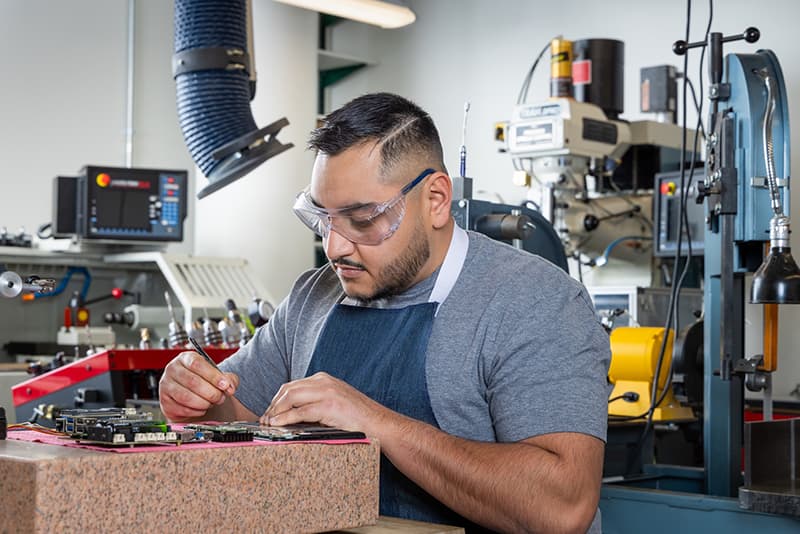
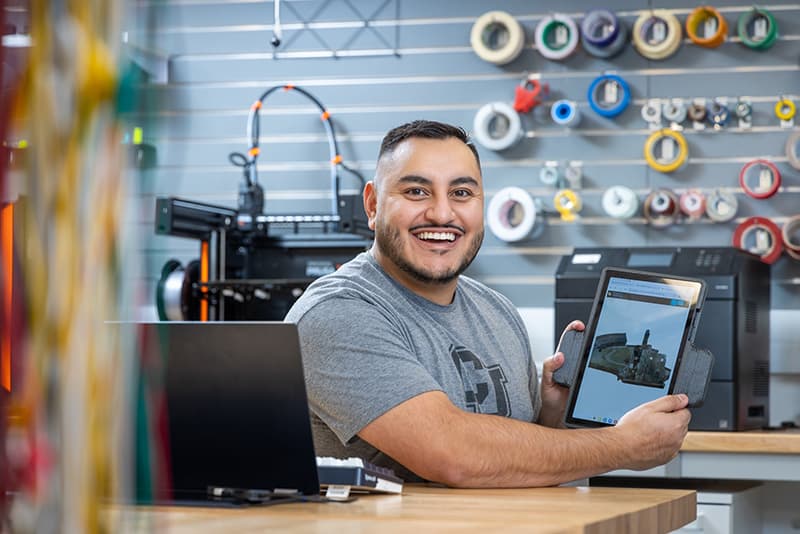
Omar also connected with the Office of Undergraduate Research and Creative Activities through the highly competitive EUReCA Summer Fellows Program, which provided funding and mentorship that helped him grow into his role as a researcher. His research focuses on accessibility and emerging technology. Omar is part of Dr. Roger’s 3D imaging research team, in which he contributes to a project connected to the ruins of a castle in Ireland that uses augmented reality to help people with mobility limitations experience historical sites that may otherwise be difficult or impossible to access.
The work brings together physics and engineering, including three-dimensional imaging and hardware design. As part of the project, Omar helps design components for a standalone, accessible tablet built specifically for use in real-world settings. “This device will allow users to engage with augmented reality content on site, offering an alternative way to explore and understand historical spaces without physical barriers,” Omar explained.
Presenting this work has been a source of growth. Omar has shared his research at campus events, donor gatherings, startup showcases, and national conferences. At a major physics conference held in Denver, he presented to a large gathering of attendees, an opportunity that boosted his confidence as both a scientist and a communicator. “Presenting my research to thousands of people at that conference was a full-circle moment for me. It wasn’t just about the 3D imaging or the hardware; it was the realization that I belonged in that room as much as anyone else,” Omar said. “A highlight for me was giving my presentation in Spanish to a professor from Puerto Rico, which felt like a bridge between my identity and my work. Every presentation I’ve given, from campus showcases and donor events to national conferences, has helped me master public speaking and bridge the gap from being a chef to being a scientist who can communicate complex ideas to anyone.”
Navigating Personal Loss
As Omar’s academic momentum continued, his personal life brought unexpected challenges. During the academic year, he and his partner experienced a deeply personal loss related to pregnancy complications. It came at a moment when his responsibilities were already demanding, adding emotional weight to an already intense period.
For the first time, Omar found himself struggling with test anxiety. He was balancing rigorous coursework, scholarship expectations, and their quiet work of grief. Rather than stepping back, he chose to keep moving forward, learning how to manage pressure while staying honest with himself about what he was carrying.
The experience became a measure of his character. It revealed a capacity for discipline, resilience, and self-responsibility that did not rely on circumstance. Even under strain, Omar remained focused on his goals, determined to continue building the future he had committed to.
Looking Forward
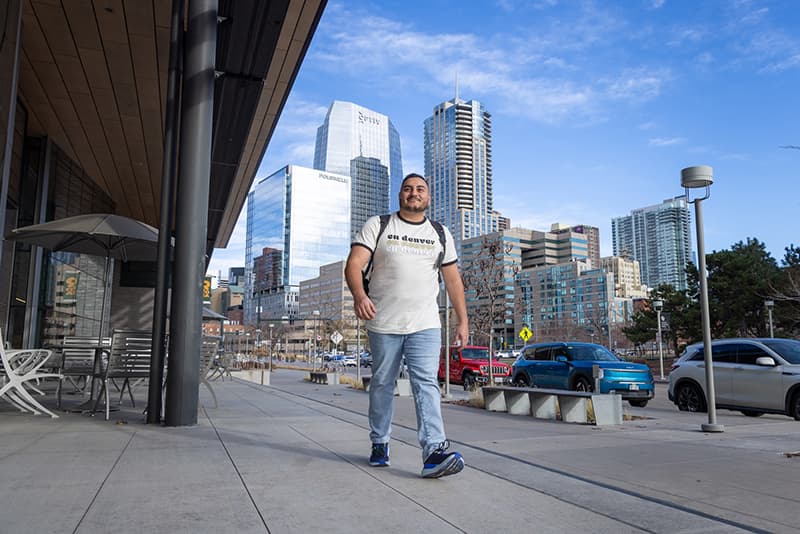
In the future, Omar plans to continue his education in physics or engineering, building on the research and applied work he is already doing. His academic trajectory reached a new milestone recently when he was accepted into the TRIO McNair Program, a highly selective initiative designed to prepare high-achieving students for doctoral studies through inessive research and mentorship. He is especially interested in developing technology that improves accessibility, with the long-term goal of turning research into tools that people can actually use. Over time, he hopes to take an entrepreneurial approach to bringing his work beyond the lab and into the real world.
Giving back is just as important to him. Growing up in a rural community with limited exposure to STEM fields, Omar understands how easily talent can go unnoticed. He wants to help students see options they may not yet recognize, whether through mentorship, sharing his own experiences, or simply encouraging them to keep asking questions. “I want students to see possibilities they might not recognize yet, and I encourage everyone to keep asking questions regardless of the circumstances,” he said. “In high school, I faced bullying that was often enabled by my teachers. At one point, I was publicly told I was limited to asking only one question a day, which eventually became just one question a week. That kind of environment limits your potential, but it shouldn't define your future. Today, as a physics major with an electrical engineering minor, I realize that asking questions is exactly what makes me successful. I didn't see those opportunities at first, but now I have the space to ask as many questions as I need to build something meaningful.”
Omar also encourages students to seek out and apply for the resources available to them. As CU Denver’s philanthropic community invests more and more in scholarships, academic support initiatives, and experiential learning opportunities, he is hopeful that more students will benefit from their impact by putting in time and effort to access them, just as he did.
For Omar, CU Denver has been more than a place to earn a degree. It has been a place where effort is met with opportunity, and where he has been able to rebuild his path with clarity and purpose. With opportunities outside of the classroom to build a strong resume, education becomes not just a credential, but a starting point for meaningful work and a fulfilling life.