Section 5: Fire-Fighting Measures
This section covers the requirements for fighting a fire caused by the chemical or arising in its vicinity.
Section 6: Accidental Release Measures
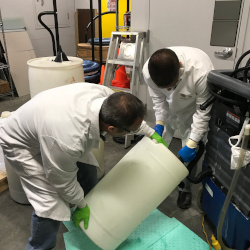
This section recommends the appropriate response to spills, leaks, or releases in order to prevent or minimize the adverse effects on people, property, and the environment from the chemical.
Section 7: Handling and Storage
This section provides guidance on the safe handling practices that minimize the potential hazards to people, property, and the environment from the chemical.
Section 8: Exposure Controls/Personal Protection
This section gives recommendations regarding appropriate engineering controls and individual protection measures such as personal protective equipment (PPE).
Section 9: Physical and Chemical Properties
This section provides empirical data about the chemical in question to include (when available): appearance, odor, odor threshold, pH, melting/freezing point, initial boiling point and boiling range, flash point, evaporation rate, flammability, upper/lower flammability or explosive limits, vapor pressure, vapor density, relative density, solubilities, octanol-water partition coefficient, auto-ignition temperature, decomposition temperature, and viscosity.
Section 10: Stability and Reactivity
This section describes reactivity hazards of the chemical and also indicates if the chemical is stable or unstable under normal ambient and anticipated storage and handling conditions of temperature and pressure. This section also describes: a) any stabilizers which may need to be used to maintain product stability, b) conditions that would create a hazard, c) conditions to avoid. Also covered under this section are a list of chemical classes that may react with the material to produce a hazardous situation and known or reasonably anticipated hazardous decomposition products.