Sign In
 

Hospital Medicine Education


The hospitalist faculty at the University of Colorado Hospital are collectively seen as some of the best educators in our system and innovators in curriculum development.  

While the hospitalist training program is the cornerstone of our educational mission at the University of Colorado, we are broadly ensconced in all aspects of medical training at the University of Colorado Denver.  In addition to being outstanding educators, our faculty lead the internal medicine and palliative care fellowship programs, teach on the medical wards, provide instruction at the medical school, and proctor nurse practioner students. 

Additionally, our faculty includes nationally known speakers who have delivered high quality presentations at numerous regional and national venues.  The end result is that ample opportunity and mentoring exist for anyone who wants to become an expert educator or leader in the field of medical education.


Hospitalist Training Program

The hospitalist training program (HTP), which commenced in July 2004 and is the oldest operating comprehensive hospitalist training program in the country, strives to take a novel approach to preparing residents for a future as a hospitalist or primarily hospital-based specialist. The program, built on data showing that internal medicine trained hospitalists are generally under-prepared in several key areas, addresses important educational and mentorship needs. At the conclusion of the program, graduates are well prepared to function clinically as a hospitalist also to act as leaders and change agents in improving healthcare systems. 


HTP Tracks

The HTP is available to up to 24 residents and there are two pathways within the HTP. The Traditional Track accepts applications toward the end of the intern year for entry into the two-year program that commences after a standard categorical intern year. This pathway expertly trains learners to become outstanding hospitalists with special emphasis on quality improvement, patient safety, hospital efficiency and system redesign. There is an additional focus on hea​lthcare finance, the business of medicine and the development of basic leadership skills. 

Starting in 2011 there will be a limited number of positions available at the intern level through the NRMP Match. This Leaders Track enrolls HTP residents in a three-year program commencing at the intern level and is geared towards those learners looking to take on major leadership roles in hospital medicine, quality improvement or hospital administration. The Leaders Track includes additional non-clinical offerings in the intern year prior to joining the Traditional Track residents for the second and third year curricula.

Both pathways utilize the backbone of the categorical track rotations such that residents are integrated into the overarching residency program and graduate with expertise in both in- and out-patient medicine. However, the HTP substitutes track-specific clinical rotations for other general medical rotations to tailor the training to the needs of future hospitalists. The HTP also includes immersion training in quality improvement, patient safety and hospital efficiency with an emphasis on mentored implementation of quality improvement projects. Additional program features include an individualized mentorship program, a hospitalist-focused journal club, a monthly project conference that affords the housestaff the chance to utilize the key tools and tenets of hospital medicine, opportunities to publish and present work at a regional and national level and biannual retreats (Fall in Vail, Colorado; Winter in Winter Park, Colorado).


​ROTATIONS

Hospitalist residents work closely with University of Colorado hospitalist faculty and are exposed to an innovative curriculum during their hospitalist rotations. Current rotations include a Hospitalist Preceptorship month that teaches residents the key curricular and structural components to be an outstanding hospitalist.  The Consultative and Perioperative Medicine rotation offers ample opportunity to learn the tenets of co-management of surgical patients, medical consultation and acute stroke management.  While rotating on the inpatient Acute Care for the Elderly service, hospitalist residents will learn how to expertly care for frail elderly patients, including the importance of care transitions.  Finally, all residents design  and implement a process or quality improvement project culminating with a one-month Quality Improvement rotation.  Many residents have turned this activity into scholarly activity, giving them a head start on an academic career.  All rotations are available as electives for those who are not in the program


Hospitalist Preceptorship

Residents spend one month during their second and third year on the preceptorship rotation. During this month the resident has one-on-one interaction with a hospitalist faculty member rotating in a hospitalist model of care. While on service they staff new admissions and consultations daily, work with a multi-disciplinary team and learn first-hand about hospital systems of care and quality improvement. A daily didactic curriculum focuses on learning and understanding the hospital system and the hospitalists' interaction with it. 

Specific Topics in Preceptorship Curriculum:

  • Medical billing and coding
  • Hospital efficiency and throughput
  • Implementing patient safety measures
  • Working with Advance Practice clinicians
  • Transitions of care for the Un/Underinsured


Consultative, Perioperative Medicine and Stroke

Residents spend one month during their second and third year on the consultative and perioperative rotation. Data supports that nearly one-third of a hospitalists' job consists of consultative, perioperative and neurological work.This rotation stresses the co-management model of care whereby patients are seen collaboratively with our orthopedic and neurologic colleagues. Additional consultative work is provided to other non-medical services. Daily  didactics stress key issues such as the pre-operative cardiac and pulmonary evaluation, perioperative diabetes and steroid management, the prevention of post-operative venous thromboembolism and the management of post-operative fever. The neurology component stresses the medical management of the acute stroke patient.  As a member of the Acute Stroke Team, HTT residents see first-hand the presentation and amanagement of acute ischemic and hemorrhagic strokes. Neurology-traidend hospitalists guide the residents through the physical exam, imaging interpretation and management of acute stroke and TIA.  These clinical offerings are complemented by didactics surrounding secondary prevention and hypertensive and glycemic control as well as general neuroanatomy and the physical exam.  Other acute neurologic disease states are covered as well. 

Specific Topics in Consult & Perioperative Medicine Curriculum:

  • Perioperative evaluation, including Cardiac and Pulmonary evaluations
  • Perioperative care, including glycemic control and steroid management
  • Prevent care in the Perioperative period, including delirium and venous thromboembolism
  • Principles of co-management


Acute Care for the Elderly

Recognizing that 20% of the population will be over the age of 65 years old and that this population suffers the highest burden of hospital avoidable harm, we have developed an inpatient geriatrics rotation focused on improving care of this vulnerable population.

All HTT residents rotate on this hospitalist-run service in the 2nd year.  A formal curriculum in hospital-based geriatrics has been developed and is taught through out the course of the month.  Additionally, resdients round with a multi-disciplinary team, which includes geriatricians, physical therapists, social workers, pharmacists and nurses all focused on improving the care we give to our elderly poplulation.  The ACE service aims to integrate a vulnerable population, a multi-disciplinary team and the learners burgeoning skills in process improvement to produce rapid tests of change, PDSA cycles and in-depth process improvement projects to ultimately provide the saftest, highest quality of care.

Specific Topics in the ACE Curriculum:

  • Physiology of Aging
  • Medications in the Elderly
  • Dementia and Delirium in the Elderly
  • Advanced Directives and Resuscitation


Palliative Care

Palliative care and end-of-life decision making are domains of hospitalist practice.  Still, few hospitalists have formal training in these areas.  The palliative care rotation incorporates both inpatient and outpatient palliative care with dedicated didactics to help improve this educational and experiential mismatch.  The rotation is a perfect complement to the annual palliative care retreats.

Specific Topics in Palliative Care Curriculum:

  • End-of-life decision making
  • Communication
  • Pain and symptom management
  • Determining decision-making capacity
  • The hospice benefit
  • Coordinating transitions of care


Quality and Systems Improvements

As part of the longitudinal QI curriculum present throughout the HTT track, this month provides HTT residents dedicated time to deepen their understanding of quality improvement (QI) principles and implement their projects.  Higher level teaching sessions are provided throughout this month which are complemented by QI coaching for each QI team.  Residents are able to put into effect small tests of change in a live environment.  This month serves to cement knowledge and skills residents have gained through authentic experience in QI.

Specific Topics in Quality and Systems Improvement Month:

  • Tools for quality improvement
  • Interpreting quality data
  • Graphical presentation of change data

Hospitalist Training Track Curricula


Longitudinal Curriculum

The promis​e of the hospital medicine movement is that hospitalists will provide higher quality care. However, this will not done by simply becoming better clinicians, rather through systematic quality improvement. Therefore we have developed a comprehensive curriculum focused on providing future hospitalists with the knowledge and skills required to become successful change agents in patient safety and quality improvement. Delivered in twelve, 4-hour sessions, the curriculum covers concepts of quality improvement, patient safety, the business of medicine, medical education and health care policy as they pertain to a practicing hospitalist. The teaching sessions also provide leadership skills that will enable our graduates to translate their patient safety and quality improvement knowledge into actionable process improvements. The sessions are highly interactive, informative and fun. Residents have the opportunity to apply the skills learned during these sessions during their formal, mentored QI project time. In the end, residents graduate well prepared to immediately improve the healthcare systems they enter as hospitalists.

Specific topics in the HTT Longitudinal Curriculum:

  • Quality improvement, including Tools of QI, Leading change and Implementing tests of change. Residents apply the knowledge and skills learned during QI rotation
  • Business of Medicine, including Business Drivers, Understanding Financial Statements, and the CEO's mindset
  • Health Care Policy, including the Role of the Physician in Health Care Policy, Understanding Medicaid and Medicare, and a visit to the Colorado State Capitol

Career Development Curriculum

As part of the longitudinal curriculum, the program prepares future hospitalists for the rigors of attaining and succeeding in their future profession.

Specific topics in Career Development Curriculum:

  • Developing an effective curriculum vitae
  • Techniques for successful job interviewing
  • How to approach contract negotiations
  • Differentiating academic and community hospitalist jobs

Quality Improvement Curriculum

All HTT residents participate in a longitudinal quality improvement project with the University of Colorado Hospital. The faculty-mentored QI project provides the experiential component to the 2-year curriculum, which includes an elective month dedicated to QI. The didactic curriculum covers the key tenets of QI and patient safety and teaches residents how to develop, implement and measure a QI project. The goal is to inspire and equip physicians to function as change agents in their future roles as hospital leaders.

The cornerstone of the QI curriculum is experiencing quality improvement first-hand as change agents for a quality improvement project at the University of Colorado Hospital (UCH). HTT residents work on a team-based project along with University Hospital stakeholders to improve hospital processes. The projects are closely mentored by hospitalist faculty with additional QI expertise and support from the group at each step of the project.

Recent Quality Improvement Projects:

  • Reducing Informal Restraints in the Frail Elderly Patient.  Faculty mentor: Heidi Wald, MD
  • Improving Quality and Timeliness of Residents' Discharge Summaries.  Faculty Mentor: Darlene Tad-y, MD
  • System Redesign to Achieve Rapid Thrombolytic Treatment of Stroke: Applying Interdisciplinary QI Principles to Treat Patients in the Golden Hour.  Faculty mentor: Ethan Cumbler, MD, FACP
  • Physician-centered Initiative to Reduce Inpatient Falls at the University of Colorado Hospital.  Faculty mentor: Dimitriy Levin, MD​


HTT Scholarship

Hospitalist residents are provided ample opportunities to participate in scholarly activities.

Project Conference

​This monthly conference allows HTT residents to use the basic concepts they are learning. All residents rotating on a hospitalist month present a short project to the HTT residents and hospitalist faculty. Conferences are themed around important tenets of hospital medicine such as patient safety, healthcare finance, hospital efficiency, healthcare policy and quality improvement.

Hospital-based Research

Residents are allowed to use 1-2 months during their residency toward completing a research project. Several hospitalist residents have chosen to work with our hospitalst faculty on hospital-based clinical research and quality improvement research projects.

Quality Improvement

In addition to traditional clinical research, HTT residents also participate in systems redesign and process improvement projects in various settings within the hospital. Residents are not limited to the longitudinal QI project built into the HTT track. ​​


Recent HTT Resident Scholarship

Publications
Borne R, Cumbler E, Glasheen JJ. Reducing polypharmacy: is hospitalization the right time? Arch Intern Med. 2011 May 9;171(9):869; author reply 870.

Research/Innovations Abstract Presentations
Anderson M, Go A, Levin D. Proton pump inhibitor use in hospitalized medical patients. Society of Hospital Medicine National Meeting, Dallas, Texas. 2011. Poster.

Mertz C and Zehnder N. Epidemiology of Social Delays in Discharge. Rocky Mountain Hospital Medicine Symposium, Denver, Colorado. 2010. Poster.

Guerrasio J, Cumbler E. Anderson M, Guiton G, Hodgson C, Aagaard E. A Computerized Patient Case Simulator: A Window Into How We Think. Rocky Mountain Hospital Medicine Symposium, Denver, Colorado. 2010. Poster.

Anderson M, Go A, Levin D. Proton pump inhibitor use in hospitalized medical patients. Rocky Mountain Hospital Medicine Symposium, Denver, Colorado. 2010. Poster.

Vignette Abstract Presentations

2011
Harrington K, Coffey D, Levin D. Anasarca of an unusual etiology. Society of Hospital Medicine National Meeting, Dallas, Texas. 2011. Poster.

2010
Jennings K, Cumbler E. Signs of Catastrophe: Characterizing Acute In-hospital Strokes. Rocky Mountain Hospital Medicine Symposium, Denver, Colorado. 2010. Poster.

Hodges S, Lavelle J, Cumbler E. Not Your Mothers Gallstones. Recurrent Cholangitis Associated with Bilirubin Stones. Rocky Mountain Hospital Medicine Symposium, Denver, Colorado. 2010. Poster.

Dalton K, Tad-y D, Cumbler E. A Penetrating Etiology of Chest Pain. Rocky Mountain Hospital Medicine Symposium, Denver, Colorado. 2010. Poster. -Semifinalist QuantiaMD/Journal Watch National Case Challenge Competition.

Harrington K, Coffey D, Levin D. Anasarca of an unusual etiology. Rocky Mountain Hospital Medicine Symposium, Denver, Colorado. 2010. Poster.

Sleesman J, Zehnher N, Misky G. Wading without Waders: A Dangerous Endeavor. Rocky Mountain Hospital Medicine Symposium, Denver, Colorado. 2010. Poster.

Sweigart J, Wolfe B, Chen E. Cavitary Lung Lesion as a Herald for Malignant Thromboembolism. Rocky Mountain Hospital Medicine Symposium, Denver, Colorado. 2010. Poster.

Reichelt K and Glasheen J. Performing Under Pressure. Rocky Mountain Hospital Medicine Symposium, Denver, Colorado. 2010. Poster.

Miles M and Zerzan J. Bad Trip: An Acidotic Misadventure. Rocky Mountain Hospital Medicine Symposium, Denver, Colorado. 2010. Poster.

Inman R, Kern D and Pell J. An Uncommon Cause of Cortical Vision Loss and Progressive Neurological Decline. Rocky Mountain Hospital Medicine Symposium, Denver, Colorado. 2010. Poster.

Harry E, delPino-Jones A, Tad-y D, Glasheen J . Air Under the Diaphragm? Not Always an Indication for Surgery… Rocky Mountain Hospital Medicine Symposium, Denver, Colorado. 2010. Poster.

2009
Zaemisch R, Graves A, Jones W, Cumbler E. Improving the Quality and Timing of Inpatient Stroke Alerts. Rocky Mountain Hospital Medicine Symposium, Denver, Colorado. 2009. Poster.

Hubbell S, Bridenstine M Frank M, Janssen W, Maloney J. Rash, Renal Failure, Regurgitant Murmurs, & Ruptured Aneurysms: Getting to the heart of the matter. Rocky Mountain Hospital Medicine Symposium, Denver, Colorado. 2009. Poster.

Hubbell, S and Zehnder, N. No Stones About It: Renal Infarction Mimicks Renal Colic. Rocky Mountain Hospital Medicine Symposium, Denver, Colorado. 2009. Poster.

Hospital Medicine Fellowship

Recognizing that many physicians finish residency unprepared to become highly functioning hospitalists we have developed an innovative fellowship training program constructed from the key tenets of our hospitalist training program but modifiable to the needs of the trainee.  This is especially attractive to internal- and family medicine-trained physicians from programs without a strong critical care background.  The program is also ideal for practitioners who have been away from hospital medicine for years and are looking to transition into the role of hospitalist.  The program excels at teaching both the clinical and non-clinical aspects needed to be an outstanding hospitalist in either an academic or community environment.

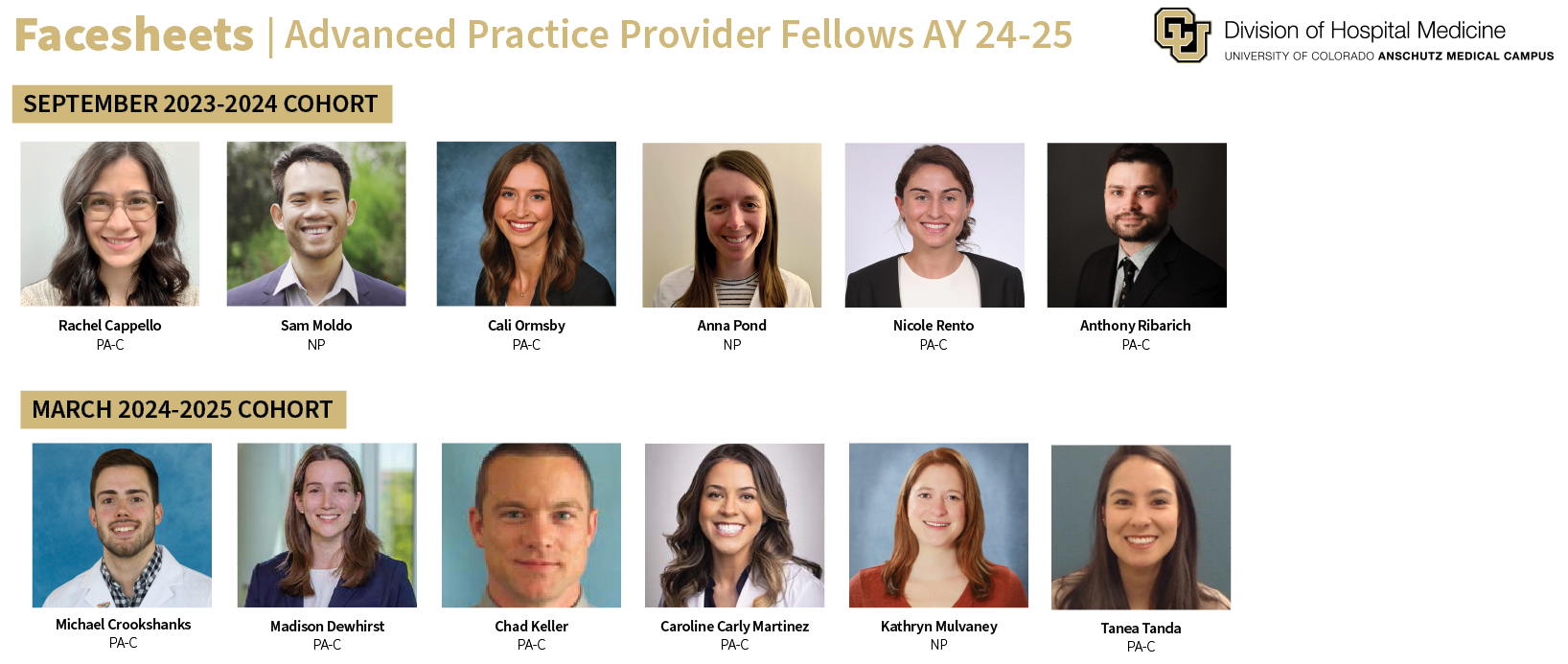
Advance​d Practice Fellowship in Hospital Medicine


Background
The APF is a one‐year fellowship program developed to help early‐career Nurse
Practitioners and Physician Assistants (or those coming back to hospital‐based medicine)
succeed in the inpatient environment. Recognizing that Advanced Practice Clinician
providers are increasingly being utilized in the hospitalist model, our goal is to ensure NPs
and PAs have the necessary skills to succeed. Ideal candidates are those interested in
becoming a hospitalist or working in a primarily hospital‐based specialty. The APF is the
first of its kind in the country, having started in 2009, and builds on the successes the
University of Colorado Hospital Medicine Group has had in developing its Hospitalist
Training Program for Internal Medicine Residents.

Program Description
The program uses a step‐wise approach to developing learners into well‐rounded,
competent inpatient providers. It has a strong clinical core but also utilizes frequent
didactic sessions, case‐based learning and simulation. Fellows will find dedicated MD, NP
and PA faculty educators who are always available to assist their learning. The program
utilizes a three‐phase system:

Phase 1: Professional Development (8 weeks)
The focus is more on the learner. This phase focuses on development of expertise in
clinical proficiency and the basics of inpatient medicine. Concepts taught include: physical
exam; communication with patients, attendings and other providers; efficiency in patient
care; effective order writing; clinical reasoning and clinical medicine. This phase utilizes
frequent didactics, group sessions and simulation in the University of Colorado Simulation
Center. Average patient load (2‐6, mostly observation level patients) is kept low to ensure
skills are mastered. Dedicated didactic time daily.

Phase 2: Clinical Development (8 weeks)
The focus turns more to clinical medicine with a focus on the development of clinical
competence. Weekly reading assignments complement clinical didactics in a case‐based
framework. Average patient load increases to 10 while the patient complexity shifts more
toward inpatient levels of complexity. Dedicated didactic time daily.

Phase 3: Skills Refinement (36 weeks)
The focus of the third phase shifts toward more autonomous practice while sampling
different care environments. Learners rotate weekly through nine 4‐week blocks as
follows:

• Week 1: Evenings (2p‐10p)
Focus on refining admission skills through caring for a high‐acuity panel of
patients while developing triage skills. Dedicated didactic time daily.
• Week 2: Nights (7p‐3a)
Focus on further refining triage skills and efficiency through cross coverage
and admission of high‐acuity medical patients. Dedicated didactic time daily.
• Week 3: Subspecialty (days)
Focus on developing skills in neurology, stroke, geriatrics, palliative care and
consultative and comanagement medicine or other specialty of learner’s
interest. This is also an opportunity for exposure to potential employers for
the coming year. Learners will have 4 weeks of vacation during this time.
Other weeks will be spent on neurology, palliative care, geriatric or
consult/comanagement services. Dedicated didactic time daily.
• Week 4: Oncology (days)
Focus on the medical care of cancer patients. Didactic curriculum focusing
on oncology treatment while further introducing and revisiting key tenets of
acute medicine. Dedicated didactic time daily.

Optional Subspecialty Training (4 weeks)
This optional rotation can be set up as part of the fellowship as an apprenticeship prior to
starting work in a hospital subspecialty. As graduates of the APF are expected to take jobs
in hospitals, this extra rotation can be utilized to apply recently acquired general medical
skills to a subspecialty area prior to commencing a job in that field. For example, an APF
interested in a position in the cardiac, neurosurgical or bone marrow transplant field could
do an elective month rotation in that area of interest at the University of Colorado Hospital.
Rotations are subject to approval by the APF and Subspecialty Director and are completely
optional. This additional month is not guaranteed to all AP Fellows.

Other Features
The APF program utilizes simulation 3‐4 times during the year to objectively measure the
learner’s progress. We also enroll learners in the Hospitalist Training Program curriculum
such that they receive up to 50 hours of learning regarding healthcare finance, hospital
business, quality improvement and patient safety. This culminates with the opportunity to
develop and implement a QI project. Additionally, the fellows will receive instruction on the
job market, résumé development and contract review and negotiation. Finally, fellows
attend our monthly Journal Club, Project Conference and Grand Rounds as well as our
annual Palliative Care Educational Retreat and the Rocky Mountain Hospital Medicine
Symposium.

Hours
The APF is generally a Monday‐Friday program with 10‐hour days. During the third phase
the fellows will rotate on the evening and night shifts as noted above. Fellows receive 4
weeks of vacation throughout the year, which must be taken during the third week of the
third phase blocks (AP Fellows will have 7‐9 weeks from which to choose to take their 4
weeks of vacation).

Salary and Benefits
The APC fellows are full faculty members at the University of Colorado. We offer a
competitive fellowship salary which will be discussed during the interview process. The
benefits package is the same as that offered to other faculty members. This is a one‐year
fellowship with an optional subspeciality month (with APF Director approval) with no
guarantee of employment beyond the fellowship period.

Application
We are currently hiring for Academic Year 2014 (July 2013 - June 2014).  The job posting is available at www.jobsatcu.com​ and search posting number: F00172. If you have additional questions, you may also email Emilie Wagner at emilie.wagner@ucdenver.edu.

Faculty Teaching Highlights

Our faculty is well recognized as educational leaders locally and nationally.

Institutional teaching awards
The following individuals were nominated by the Medical School Class of 2008 for their annual teaching award giving to the best teacher in the medical school.

Jeff Glasheen
Jeannette Guerrasio
Greg Misky
Adam Trosterman

National teaching awards
Dr. Jeffrey Glasheen, a former winner of the Division of General Internal Medicine’s Elaine Cleary award for excellence in education, was the 2007 recipient of the Society of Hospital Medicine’s Award for Teaching Excellence.  This national teaching award is given annually at the National Society of Hospital Medicine meeting to the most outstanding hospitalist educator in the country.

Teaching Scholars Program
Dr. Adam Trosterman was accepted into the University of Colorado Denver's Teacher's Scholars Program. The TSP is an intensive, 18-month program aimed at developing physicians into expert educators while inculcating the necessary skills to develop, refine, and evaluate curriculum development.

Resident as Teachers
Recognizing the essential role that housestaff play in the educational process of fellow residents and students, Dr. Adam Trosterman has developed an innovative program to teach core educational skills to medical housestaff.

Learner Remediation
Unfortunately not all learners find success during medical training. Dr. Jeannette Guerrasio has developed a pioneering approach to improving the experience of residents who struggle for whatever reason. This program is quickly growing to include medical students and fellows, and has garnered national attention. Dr. Guerrasio speaks locally and nationally to education faculty on identifying learners in difficulty, diagnosing the area of deficiency and creating a remediation plan. She has also spoken nationally on providing feedback.

Education Program Directors:
Jeffrey Glasheen, MD the Director of the Hospitalist Training Program, serves as an Associate Program Director for the Department of Medicine's Internal Medicine Training Program.
Jeanie Youngwerth, MD, is the Co-Director for the University of Colorado's Palliative Medicine Fellowship.
Drs. Adam Trosterman and Jeannette Guerrasio serve as Key Clinical Faculty for the Department of Medicine's Internal Medicine Training Program and the School of Medicine’s Foundations of Doctoring Course and Department of Student Affairs.

Other Opportunities


Hospital-based Research
Residents are allowed to use 1-2 months during their residency toward completing a research project.  Several hospitalist residents have chosen to work with our hospitalist faculty on hospital-based clinical research and quality improvement research projects.


Palliative Care Medicine Retreat
This annual 2-day event takes place at a mountain hut just outside of Vail, Colorado.  It is proctored by nationally renowned palliative care experts as well as our hospitalist faculty who practice palliative care.  The focus of the meeting changes annually but it is always a great opportunity to unite hospitalist faculty and residents for two days of great learning and a lot of fun.  The retreat starts on a Saturday afternoon with participants hiking or biking into the hut and is followed by several hours of an interactive workshop.  The evening time is reserved for a barbecue and socializing followed by a morning of palliative care didactics and another hike/bike out. 


Longitudinal Curriculum
The promise of the hospital medicine movement is that hospitalists will provide higher quality care.  However, this cannot be done simply by becoming better clinicians.  Therefore we have developed a comprehensive curriculum focused on providing future hospitalists with the knowledge and skills to become successful change agents in the realm of patient safety and quality improvement.  Delivered in two hour monthly sessions, early sessions utilize peer review and root cause analysis to teach the concepts of patient safety.  Later sessions focus on how to take an identified patient safety problem and turn it into a successful quality improvement project.  The final sessions focus on basic business and leadership skills such that the successful hospitalist can translate what she learned about patient safety and quality improvement into actionable process improvements.  The sessions are highly interactive, informative and fun. Residents have the opportunity to apply the skills learned during these sessions during their formal, mentored QI project time.  In the end, residents graduate well prepared to immediately improve the healthcare systems they enter as hospitalists.


Career Development Curriculum
As part of the longitudinal curriculum, the program prepares future hospitalists for the rigors of succeeding in their future profession.  Topics include:  developing an effective curriculum vitae, techniques for successful job interviewing, how to approach contract negotiations and differentiating academic and community hospitalist jobs.


Examples of components of the HTT curriculum: 
 

Consult & Perioperative Curriculum

Palliative Care Curriculum

Preceptorship Curriculum

Longitudinal Curriculum

Acute Care for the Elderly (ACE) Curriculum

Stroke Curriculum

 Preoperative cardiac evaluation

End-of-life decision making

Medical billing and coding

Improving resource utilization

Delirium Prevention & Management

Neuroimaging

Preoperative pulmonary evaluation

Communication

Protocol development & use

Hospitalist models of care

Reducing polypharmacy

Appropriate use of thrombolytics

Perioperative glycemic control

Pain and symptom management

Hospital efficiency & throughput

Job search & contract negotiation

Avoiding functional decline

Hypertensive management in acute stroke

Perioperative steroid management

Determining decision-making capacity

Implementing patient safety measures

Using systems to reduce medical errors

Understanding the Medicare Benefit

Diabetes care in acute stroke

Prevention of thrombosis

The hospice benefit

Patient/family centered care

The business drivers of hospital medicine

Physiology of Aging

Management of TIA

Prevention of delirium

Coordinating transitions of care

Hospital preventive care

Understanding hospital finances

Effective multi-disciplinary models of care

Secondary prevention of stroke