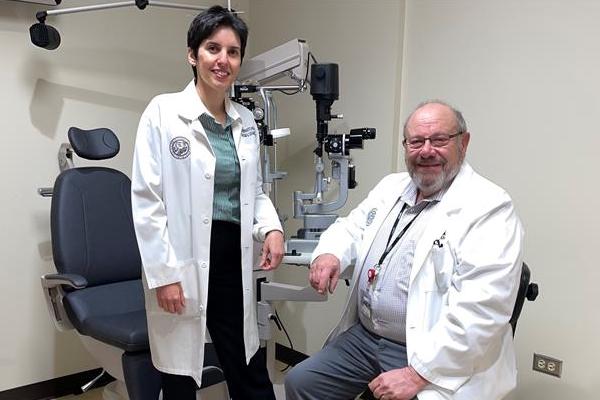
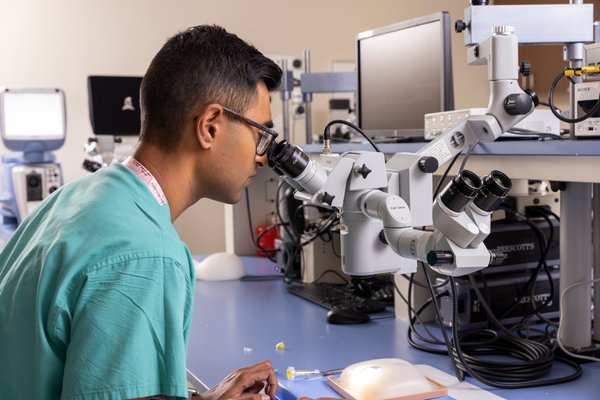
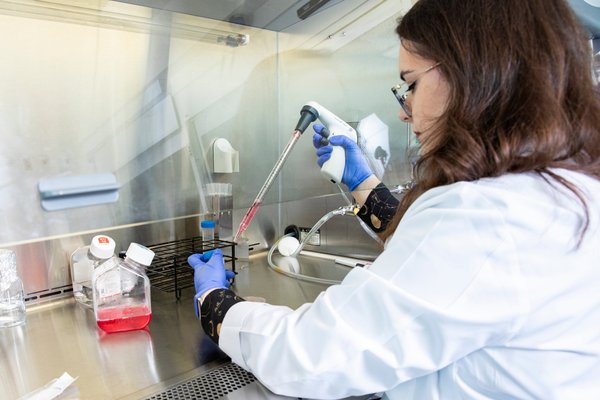
The ophthalmology residency at the University of Colorado focuses on the development of outstanding clinical and surgical skills. The experience of the residents is both broad and deep, with extensive exposure to the evaluation and management of ophthalmic diseases, common and rare.
The residents’ growth as ophthalmologists is assisted by a faculty dedicated to resident education, cutting edge research programs that keep them abreast of the latest developments, didactic teaching sessions that build a solid fund of knowledge, and busy clinic settings that balance autonomy and oversight so that residents can develop solid decision-making skills. At the end of the 3-year program residents will have a foundation that will allow them to become highly competent leaders in ophthalmology, whether in private practice or academics.
Throughout the three years of residency, the residents attend weekly basic science lectures and monthly journal clubs given by faculty to develop their fund of knowledge and their ability to review the literature critically. Weekly clinical conferences give them experience presenting cases as well as exposure to a variety of approaches in disease management. Organized “wet labs” guided by faculty allow them to hone their surgical skills prior to working on live patients.
As the only academic medical center for hundreds of miles, our residents have the advantage of working at a range of unshared university-affiliated hospitals. These include a tertiary care VA Hospital, a level 1 trauma center county hospital, a nationally recognized children’s hospital, and the Rocky Mountain Lions Eye Institute at the University of Colorado. The high surgical volume and balanced clinical experience during the 3 years at these facilities is second to none. We are proud of our training program and our residents, and we constantly strive to maintain an environment that allows them to develop into skilled ophthalmologists.
Learn more about Residency Rotations , Affiliated Institutions, and see the Residency Manual 2010.
This 12-month fellowship is based at the University of Colorado Hospital (UCH) with
activities at The Veterans Administration Medical Center (VAMC), Denver Health
Medical Center (DHMC), The Children's Hospital (TCH) and outlying private clinics.
The fellow will rotate through the corneal service of each of the major affiliated
hospitals. Primary supervision of the corneal fellow is by Doctors Michael Taravella and
Richard Davidson; other attending physicians from other ophthalmology specialties may
be involved. Doctors Taravella and Davidson are members of the full-time faculty at the
University of Colorado School of Medicine.
The primary purpose of the fellowship will be to gain educational experience in the area
of corneal transplantation and laser vision correction. The goals of training will be to
develop the appropriate clinical judgment in patient selection for corneal
transplantation and refractive surgery as well as obtaining the surgical skills to perform
these procedures effectively. An additional goal will be to obtain expertise in the area of
cornea and external disease and management of common disorders relating to this
specialty. Therefore, there is a cognitive as well as a technical skill level of expertise to
be attained during this year of training.
ROLE AND RESPONSIBILITIES OF THE FELLOW
Clinical Responsibilities: The corneal fellow will rotate to UCH, DHMC and the VAMC; he/she also will rotate to TCH for consultation. The corneal fellow will be expected to perform the majority of
transplants at the VAMC and DHMC. In addition, he/she will be expected to assist
Doctors Taravella and Davidson in performing corneal transplantation at UCH. The
fellow will be expected to staff corneal clinics for each of these hospitals and supervise
residents both in clinical care and cataract surgery. It is anticipated that the fellow will
perform between 30 to 50 corneal transplants during the year and be exposed to a full
range of corneal pathology during the training.
The fellow will perform all corneal transplants under direct faculty supervision.
During rotations at the above hospitals, the fellow will have the opportunity to recruit and
perform laser vision correction under the direct supervision of Doctor Taravella. The
number of procedures that the fellow will perform is anticipated to be between 40 and
50. The fellow will be responsible for all pre- and post-operative care of his/her
refractive patients with Doctors Taravella, Davidson or other appropriate faculty
available for consultation and supervision. It is anticipated that the fellow's abilities will
progress and improve with experience.
Core skills that the fellow is anticipated to learn include:
1. Pre-procedure evaluation of corneal transplant and refractive surgery
patients.
2. Performance of corneal transplantation and laser vision correction.
3. Post-procedure care for these procedures.
4. Supervision and teaching residents while performing cataract surgery.
5. Management of routine and complex cornea external disease problems.
(see below)
EDUCATIONAL RESPONSIBILITIES: The cornea fellow will attend all educational conferences offered by the Department of Ophthalmology including but not limited to: Grand Rounds, Case Conferences,
Department sponsored symposia, and Basic and Clinical Science Course lectures. It is
anticipated that the cornea fellow will teach portions of the cornea/external disease
Basic Science Course. The fellow will attend all journal clubs featuring cornea, external
disease or refractive surgery articles.
Educational Goals
The program will include teaching in at least the following subject areas:
1. Viral infections such as:
a. herpes keratitis
b. herpes zoster keratitis
c. adenovirus
2. Bacterial infections:
a. corneal ulcers
b. acute and Chronic Conjunctivitis
3. Unusual infections such as:
a. fungal keratitis
b. chlamydial infections
c. acanthamoeba keratitis
4. Immune-mediated disease such as:
a. ocular cicatricail pemphiyoid
b. allergic conjunctivitis
c. vernal conjunctivitis
d. corneal transplant rejection
e. Steven-Johnson syndrome
f. corneal complications of collagen-vascular disease
g. Cogan syndrome
h. interstitial keratitis
i. scleritis / episcleritis`
5. Dermatological problems:
a. rosacea
b. Steven-Johnson syndrome
6. Unusual problems such as:
a. Thygeson's punctate keratitis
b. Mooren's ulcer
7. Congenital anomalies of the anterior segment
8. Expertise in the following procedures:
a. pterygium with conjunctival autograft (supervised)
b. corneal biopsy (supervised)
c. surgical treatment of conjunctival tumors
d. lamellar keratopathy (supervised)
e. lid biopsy for suspected tumors
RESEARCH RESPONSIBILITIES: It is anticipated that the cornea fellow will complete a project of publishable quality relating to either clinical or basic aspects of cornea, external disease or refractive
surgery during the 12-month training period. Presentation at the Annual Resident,
Fellow and Alumni Research Day is required.
FUNDING: The American fellowship is funded and health insurance is included. An academic
appointment is provided at the "Instructor" level. An educational allowance is provided
for books and travel. Funding is provided for travel of a fellow presenting a paper at the
American Society of Cataract and Refractive Surgery annual meeting.
FELLOW EVALUATION: The overall responsibility for evaluating the fellow will reside with Doctors Davidson and Taravella although all faculty members will have the opportunity to comment on the fellow's performance during his/her one-year training period. Cognitive and procedural competence will be assessed in an ongoing fashion by all faculty members involved in he fellows training. Both written and verbal feedback will be provided on a quarterly basis.
APPLICATION PROCEDURES: To be considered for our fellowship programs, applicants must be able to be fully licensed in the state of Colorado by the start of the fellowship. The website from the Colorado Board of Medical Examiners has detailed information about licensing requirements for the state of Colorado. Successful completion of all three steps of the USMLE by the application deadline is required. If accepted, candidates must also pass a criminal background investigation (criteria specified in University background investigation policies).
The specific requirements for international medical graduates include, but are not limited to, graduation from a medical school approved by the Colorado Medical Board, 36 months of clinically-based postgraduate training in the United States or Canada, and one of the following: FLEX Exam (must also have passed the ECFMG exam), state written exam, or USMLE.
The CU School of Medicine recognizes that fellows enrolled in its programs are trainees, not employees. As such, all applicants also must be able to meet conditions of the institutional training agreement. Specifically, fellows in our program must be a U.S. citizen, lawful permanent resident, refugee, asylee, or possess the appropriate documentation to allow the resident to legally train at the University of Colorado Denver School of Medicine.
If, after reviewing these websites and requirements, you feel you qualify for our fellowship, please submit an application through the San Francisco Matching Program. We ask that you also submit a copy of your USMLE score report and a brief CV via email to ophthalmology.residency@ucdenver.edu by the application deadline.
Our application deadline is August 31, 2013 for a July 2014 fellowship start date.
For more information, please contact the Fellowship Coordinator.
This two-year fellowship is designed for advanced training in vitreoretinal diseases following an ophthalmology residency. The training focuses on both medical and surgical retinal diseases in adults and children. This is a fellowship available to graduates of ophthalmology residency programs and is available only to applicants with licensure to practice in the state of Colorado by the start of fellowship.
The two-year fellowship is organized as a comprehensive training period in both medical and surgical retinal disease. Standard best vitreoretinal fellowship programs require two years of rigorous vitreoretinal training in order to meet the high standards set by the academic vitreoretinal community. This two-year fellowship at the University of Colorado will meet or exceed the academic expectations because of the breadth and depth of experience that our multiple institutions have to offer. Training takes place at the University of Colorado Hospital (UCH), the Denver Health Medical Center (DHMC), the VA Medical Center (VAMC), and the Children’s Hospital of Denver (TCH).
Program Director: Naresh Mandava, M.D.
Full-time University of Colorado School of Medicine Faculty : Naresh Mandava, M.D., Jeffrey Olson, M.D., Scott Oliver, M.D., and Hugo Quiroz-Mercado, M.D., Chief of Ophthalmology and vitreoretinal attending at DHMC.
The facilities for clinical care are excellent in all four institutions. The fellow will have access to the ophthalmology library and will have a computer available to him or her at the Eye Institute. The fellow will be expected to have access to a computer outside of work as well for research and for the preparation of didactic lectures. The patient populations are diverse in all four institutions UCH, DHMC, VA , TCH making this an exceptional fellowship experience.
The principle goal of the fellowship is to train comprehensive vitreoretinal specialists who are second to none in the field. Graduates will have the ability to diagnose complex vitreoretinal disorders and interpret fluorescein angiograms, ultrasonography of the eye, as well as newer retinal imaging modalities. In addition, the ability to carefully select and perform both longstanding as well as cutting edge laser and surgical techniques will be routine for the graduate. Management of ocular oncology as well as uveitic disease of the posterior segment is expected in our clinics. The retina faculty have expertise in all these areas.
First year fellows will have a busy clinical experience involving rotations with the faculty at UCH and DHMC. The fellow will often assist in surgeries generated from the clinics at VAMC, DHMC and UCH. For the first 6 months, all operative procedures will be performed with an attending present. Following this 6-month period, the Program Director, with consultation from retina faculty, will decide if the fellow will have full privileges to operate without supervision. From the beginning of the fellowship, the fellow will have the privilege to function as an attending at all 4 institutions in the clinics, to perform office procedures and take emergency call.
The objective of the first year is to develop the skills to diagnose and develop a treatment plan for all retinal conditions. Laser procedures will be mastered in the first year and most surgical procedures can be performed by the end of the first year.
The second year fellow will perform on the attending level at VAMC, UCH, DHMC, and TCH. The second year allows opportunity for the fellow to staff retina clinics and attend surgical cases at all the institutions. Hands on experience with more complicated cases such as proliferative vitreoretinopathy and combined tractional and rhegmatogenous detachments will be plentiful. The second year fellow will also have the opportunity to operate on patients from the attending clinics with attending supervision and will have ample opportunity to fine-tune surgical skills in preparation for a comprehensive vitreoretinal practice.
EDUCATIONAL RESPONSIBILITIES: The fellow will be in charge of a monthly Fluorescein/Case Conference at which interesting cases are presented to the faculty and residents on the retina service. The residents on the retina service as well as the fellow will provide patients for the conference. In addition, retina attendings will present interesting cases to the group. The fellow will be responsible for electronically storing these cases so that they are available in a case library for future fellows and attendings. In addition, the fellow will attend other departmental conferences, including weekly Case Conference, twice-monthly Grand Rounds and monthly Quality Assurance reviews. The fellow will report his/her research at the annual Resident, Fellow and Alumni Research Day. The fellow will attend all journal clubs featuring vitreoretinal diseases. The fellow will be required to prepare and present teaching conferences and participate in the teaching of residents and medical students.
RESEARCH RESPONSIBILITIES: Research opportunities abound and each fellow is expected to complete one or more projects. Specifically the fellow will participate in clinical trials; current clinical trials include pharmacological studies in macular degeneration, retinal vascular disease, and diabetic retinopathy. In addition, research in new imaging modalities will be required. Fellows are encouraged to present their research at such meetings as the American Academy of Ophthalmology (AAO) as well as other subspecialty vitreoretinal meetings. It is anticipated that the fellow will publish one or more papers during the two year fellowship.
FUNDING: The fellowship is funded by the Department of Ophthalmology and health insurance is included. An academic appointment is provided at the "Instructor" level in the School of Medicine. Funding is provided for the follow to travel each year to present a paper at the AAO or ARVO meeting.
FELLOW EVALUATION: The overall responsibility for evaluating the fellow will reside with the four full-time vitreoretinal faculty. All faculty members involved in the fellows' training will assess cognitive and procedural competence in an ongoing fashion. Both written and verbal feedback will be provided on a quarterly basis. The fellow will maintain a surgical log, as well as a log of research activity and conferences/lectures given or attended.
The exposure to vitreoretinal diseases in the adult and pediatric populations will prepare the fellow for a rigorous career in academic vitreoretinal medical and surgical disease. The variety of pathology as well as the exposure to cutting edge technologies will make this an exceptional vitreoretinal fellowship.
APPLICATION PROCEDURES: To be considered for our fellowship programs, applicants must be able to be fully licensed in the state of Colorado by the start of the fellowship. The website from the Colorado Board of Medical Examiners has detailed information about licensing requirements for the state of Colorado. Successful completion of all three steps of the USMLE by the application deadline is required. If accepted, candidates must also pass a criminal background investigation (criteria specified in University background investigation policies).
The specific requirements for international medical graduates include, but are not limited to, graduation from a medical school approved by the Colorado Medical Board, 36 months of clinically-based postgraduate training in the United States or Canada, and one of the following: FLEX Exam (must also have passed the ECFMG exam), state written exam, or USMLE.
The CU School of Medicine recognizes that fellows enrolled in its programs are trainees, not employees. As such, all applicants also must be able to meet conditions of the institutional training agreement. Specifically, fellows in our program must be a U.S. citizen, lawful permanent resident, refugee, asylee, or possess the appropriate documentation to allow the resident to legally train at the University of Colorado Denver School of Medicine.
If, after reviewing these websites and requirements, you feel you qualify for our fellowship, please submit an application through the San Francisco Matching Program. We ask that you also submit a copy of your USMLE score report and a brief CV via email to ophthalmology.residency@ucdenver.edu by the application deadline.
Our application deadline is August 15, 2013 for a July 2014 fellowship start date.
For more information, please contact the Fellowship Coordinator.
The objectives and goals of the 2-year American Society of Ophthalmic Plastic and Reconstructive surgery fellowship at the University of Colorado Denver School of Medicine are to train a professional, ethical, and outstanding academic oculoplastic and orbital surgeon. During the course of the fellowship, the fellow is expected to gain experience in both medical and surgical aspects of functional and cosmetic oculofacial plastic surgery. Additionally, training will include ample opportunity for research and education. The University of Colorado fellowship will also provide the fellow the opportunity to participate in patient care in the fields of otolaryngology, general plastic and reconstructive surgery, neuro-ophthalmology, MOHS dermatologic surgery, cosmetic dermatology, neurosurgery, head and neck surgery, and ophthalmic pathology.
Primary preceptor is Vikram D. Durairaj, M.D., F.A.C.S.; Associate preceptors are Robert Fante, M.D., Michael Hawes, M.D., Eric Hink, M.D., Michael McCracken, M.D., and Brian Willoughby, M.D.
APPLICATION PROCEDURES: To be considered for our fellowship programs, applicants must be able to be fully licensed in the state of Colorado by the start of the fellowship in July of even numbered years. The website from the Colorado Board of Medical Examiners has detailed information about licensing requirements for the state of Colorado. Successful completion of Step 1 and Step 2 (CS+CK) of the USMLE by the application deadline is required. Successful completion of USMLE Step 3 by the fellowship start date is required. If accepted, candidates must also pass a criminal background investigation (criteria specified in University background investigation policies).
The specific requirements for international medical graduates include, but are not limited to, graduation from a medical school approved by the Colorado Medical Board, 36 months of clinically-based postgraduate training in the United States or Canada, and one of the following: FLEX Exam (must also have passed the ECFMG exam), state written exam, or USMLE.
The CU School of Medicine recognizes that fellows enrolled in its programs are trainees, not employees. As such, all applicants also must be able to meet conditions of the institutional training agreement. Specifically, fellows in our program must be a U.S. citizen, lawful permanent resident, refugee, asylee, or possess the appropriate documentation to allow the resident to legally train at the University of Colorado Denver School of Medicine.
If, after reviewing these websites and requirements, you feel you qualify for our fellowship, please submit an application through the San Francisco Matching Program. We ask that you submit the following supplemental materials either through SFMatch if accepted, or via email to ophthalmology.residency@ucdenver.edu by the application deadline: Complete CV, copy of Medical School transcripts, copy of USMLE scores, copy of OKAP scores, and a recent photo.
Our application deadline is December 31, 2012 for a July 2014 fellowship start date.
For more information, please contact the Fellowship Coordinator.
The University of Colorado Clinical Glaucoma Fellowship is a 12-month program designed to provide advanced training in the diagnosis and management (medical and surgical) of the various types of glaucoma in adults and children. This fellowship is available to graduates of an ACGME accredited ophthalmology residency program who are eligible for licensure to practice medicine in the state of Colorado by the start of fellowship in July of each academic year.
The fellowship is based at the University of Colorado Hospital (UCH) and the Rocky Mountain Lions Eye Institute (RMLEI). Primary supervision of the glaucoma fellow is by Doctors Malik Kahook and Mina Pantcheva who are members of the full-time faculty at the University of Colorado School of Medicine. The fellow will also rotate through the glaucoma service at each of the three major affiliated hospitals working with that sites respective full time faculty as listed below:
The Denver Veterans Administration Medical Center (VAMC)
- Douglas MacKenzie, MD
Denver Health Medical Center (DHMC)
- Nicholas Faberowski, MD
Children's Hospital of Colorado (CHC)
- Mina Pantcheva, MD
All four institutions offer excellent clinical and surgical facilities during fellowship. The fellow will have full access to all the facilities of the UCH and the RMLEI. This will include access to the Denison Library Web Site, access to major medical journals online, as well as access to a library of ophthalmic reference materials ranging from textbooks to atlases.
The principle goal of the fellowship is to prepare trainees to become capable comprehensive glaucoma specialists in either an academic or community setting. Graduates will have the ability to not only assess and diagnose the different glaucomatous diseases, but to develop appropriate and effective medical and surgical treatment plans as well. The acquired skill set obtained will include interpretation of optical coherence tomography, Heidelberg retinal tomography, visual fields, B-scan ultrasonography, ultrasound biomicroscopy, as well as newer glaucoma imaging modalities. In addition, the ability to carefully select and perform both longstanding as well as cutting edge laser and surgical techniques will be routine for the graduate.
ROLE AND RESPONSIBILITIES OF THE FELLOW
Clinical Responsibilities: The glaucoma fellow will participate in tertiary care clinics with both Dr. Kahook and Dr. Pantcheva at the University of Colorado Hospital Eye Center. In addition, the fellow will also be responsible for staffing his/her own glaucoma clinics on a weekly basis at the Rocky Mountain Lions Eye Institute. In the clinic, the fellow will routinely use one of the several diagnostic imaging technologies available and become fluent in the indication and interpretation of each modality. A list of currently available entities includes:
- Humphrey and Goldman Visual Fields
- Spectral-Domain OCT
- Heidelberg Retinal Tomography (HRT)
- B-scan ultrasonography
- Ultrasound biomicroscopy (UBM)
- Other experimental/novel devices
A large number of laser procedures will be routinely performed including:
- Laser Peripheral Iridotomy (LPI)
- Laser Trabeculoplasty (SLT and ALT)
- Laser suture lysis
- Laser bleb revision
- Trans-scleral cyclophotocoagulation.
The fellow will be active in the surgical care of patients and will act as primary surgeon on numerous established and novel surgical procedures including:
- Trabeculectomy
- Glaucoma drainage devices (Ahmed, Baerveldt)
- Ex-PRESS Filtration Device
- Endoscopic cyclophotocoagulation
- Trabectome and Phacotrabectome
- Canaloplasty and Phacocanaloplasty
- Goniotomy and Trabeculotomy
- Clear corneal phacoemulsification (including complex, traumatic, and pseudoexfoliation cataracts)
- Femtosecond Laser Assisted Cataract Surgery (Starting 2012)
- Other novel minimally invasive glaucoma surgical techniques
The fellow will also participate in glaucoma clinics and surgery at the DVAMC and DHMC. Both centers have busy surgical services and a wide range of pathology that will complement the fellow’s educational experience under the supervision of Dr. Douglas Mackenzie (VA) and Dr. Nicholas Faberowski (DHMC). The fellow will also staff his/her own glaucoma clinics on a weekly basis at the VAMC and monthly at DHMC. The bulk of pediatric glaucoma patients will be seen on Dr. Pantcheva’s service with surgeries performed at the Children’s Hospital of Colorado. Pediatric glaucoma patients may also be seen as necessary at the CHC eye clinic. At-home general ophthalmology call will be split between department faculty and fellows. The glaucoma fellow can expect to take approximately 6 weeks of call per academic year, serving as attending for residents on call.
RESEARCH RESPONSIBILITIES: The glaucoma fellow is expected to complete one or more research projects during their training. They will also participate in ongoing clinical trials involving medical therapies, surgical interventions, glaucoma imaging, and others. Participation in animal lab studies will also be available through current work led by Dr. Kahook. The fellow is encouraged to present their research at academic meetings such as the American Academy of Ophthalmology (AAO), Association for Research in Vision and Ophthalmology (ARVO), and American Glaucoma Society (AGS), as well as other subspecialty glaucoma meetings. Presentation at the University of Colorado Annual Resident, Fellow, and Alumni Research Day is required. It is anticipated that the fellow will publish one or more papers during his/her fellowship.
EDUCATIONAL RESPONSIBILITIES: The glaucoma fellow will attend all educational conferences offered by the Department of Ophthalmology including but not limited to:
- Grand Rounds
- Clinical Case Conferences
- Department sponsored symposia
- Basic and Clinical Science Course lectures
- Glaucoma related journal clubs
It is anticipated that the glaucoma fellow will teach portions of the Glaucoma Basic Science Course. The fellow will attend all journal clubs featuring glaucoma diseases. The fellow will be required to prepare and present teaching conferences and participate in the teaching of residents and medical students.
FUNDING: The fellowship is funded by the Department of Ophthalmology and includes a very competitive salary with health care benefits. An academic appointment is provided at the "Instructor/Fellow" level in the School of Medicine. Funding is provided for the fellow to travel each year to present a paper or poster at the AAO, AGS, or other national meeting.
FELLOW EVALUATION: The overall responsibility for evaluating the fellow will reside with the full-time glaucoma faculty. All faculty members involved in the fellows' training will assess cognitive and procedural competence in an ongoing fashion. Both written and verbal feedback will be provided on a quarterly basis. The fellow will maintain a surgical log, as well as a log of research activity and conferences/lectures given or attended.
APPLICATION PROCEDURES: To be considered for our fellowship programs, applicants must be able to be fully licensed in the state of Colorado by the start of the fellowship. The website from the Colorado Board of Medical Examiners has detailed information about licensing requirements for the state of Colorado. Successful completion of all three steps of the USMLE by the application deadline is required. If accepted, candidates must also pass a criminal background investigation (criteria specified in University background investigation policies).
The specific requirements for international medical graduates include, but are not limited to, graduation from a medical school approved by the Colorado Medical Board, 36 months of clinically-based postgraduate training in the United States or Canada, and one of the following: FLEX Exam (must also have passed the ECFMG exam), state written exam, or USMLE.
The CU School of Medicine recognizes that fellows enrolled in its programs are trainees, not employees. As such, all applicants also must be able to meet conditions of the institutional training agreement. Specifically, fellows in our program must be a U.S. citizen, lawful permanent resident, refugee, asylee, or possess the appropriate documentation to allow the resident to legally train at the University of Colorado Denver School of Medicine.
If, after reviewing these websites and requirements, you feel you qualify for our fellowship, please submit an application through the San Francisco Matching Program. We ask that you also submit the following supplemental materials via email to ophthalmology.residency@ucdenver.edu by the application deadline: Complete CV, copy of USMLE scores and (optional) copy of OKAP scores and recent photo.
Our application deadline is August 31, 2013 for a July 2014 fellowship start date.
For more information, please contact the Fellowship Coordinator.
Program Director: Malik Kahook, MD
Full-time University of Colorado School of Medicine Faculty : Malik Kahook, MD, Mina Pantcheva, MD, Nicholas Faberowski, MD, and Douglas MacKenzie, MD
Pediatric Fellowship
The University of Colorado Pediatric Ophthalmology and Adult Strabismus Fellowship is a 12-month program designed to provide advanced training in the diagnosis and management of medical and surgical ophthalmic conditions of children and adults with strabismus. This fellowship is available to graduates of an ACGME accredited ophthalmology residency program who are eligible for licensure to practice medicine in the state of Colorado by the start of fellowship in July of each academic year.
The fellowship is primarily based at the Children’s Hospital Colorado. Additional clinical and surgical experience at the University of Colorado Hospital and Denver Health Medical Center will be provided. Primary supervision of the Pediatric Fellow is by Rebecca Braverman MD and Robert Enzenauer MD who are full-time faculty at the University of Colorado School of Medicine Department of Ophthalmology. Miguel Paciuc MD will supervise the fellow during their clinical and surgical opportunities at Denver Health Medical Center. Rebecca Mets MD will be joining the faculty as of October 2011 and she will participate in the education and training of the Pediatric Fellow as well.
The fellow will have full access to multiple educational opportunities provided by the Department of Ophthalmology at the Rocky Mountain Lions Eye Institute (RMLEI) including: morning reports, grand rounds and journal clubs. Topics specifically relevant to the fellowship will be provided by the above named faculty by informal teaching sessions, journal clubs and small group didactic lessons. The fellow will have access to medical journals through the University of Colorado Denison Library.
The Pediatric and Adult Strabismus Fellowship will provide trainees the knowledge and surgical skill to care for patients with both common and rare disorders within the realm of the specialty. Graduates will be exposed to the medical and surgical management of ophthalmic diseases from birth including: retinopathy of prematurity, congenital cataracts and glaucoma, to those of the elderly including: strabismus secondary to intracranial neoplasms and cerebral vascular accidents. Care for common conditions such as nasolacrimal duct obstruction, strabismus, and amblyopia will be provided in the outpatient clinic setting under direct supervision by the faculty. Emergency management of traumatic eye injuries and acute infectious diseases of the eye/orbit will be provided through the Emergency Department of the Children’s Hospital Colorado. The fellow will have exposure to complex and often rare diseases on the inpatient consult service at the Children’s Hospital Colorado.
ROLE AND RESPONSIBILITIES OF THE FELLOW
Clinical Responsibilities: The Pediatric Fellow will be an integral member of the Pediatric Ophthalmology and Adult Strabismus Division. They will work closely with the faculty and residents to provide care for patients in the outpatient clinical setting, inpatient wards and in the emergency department. They will be a member of the surgical team for both pediatric and adult strabismus patients. The fellow will provide after hours on call coverage on a rotating basis with the rest of the Department of Ophthalmology fellows and faculty.
The fellow will be active in the surgical care of patients and will act as primary surgeon on procedures such as:
- Strabismus surgery on children and adults
- Nasolacrimal duct probing and intubation
- Congenital cataract extraction
- Eyelid lesion excision
- Examinations under anesthesia
RESEARCH RESPONSIBILITIES: The Pediatric Fellow is expected to complete one or more research projects during their training. The fellow is encouraged to present their research at academic meetings such as the American Association of Pediatric Ophthalmology and Strabismus (AAPOS), the American Academy of Ophthalmology (AAO), and Association for Research in Vision and Ophthalmology (ARVO). Presentation at the University of Colorado Annual Resident, Fellow, and Alumni Research Day is required. It is anticipated that the fellow will publish one or more papers during his/her fellowship.
EDUCATIONAL RESPONSIBILITIES: The Pediatric Fellow will attend all educational conferences offered by the Department of Ophthalmology including but not limited to:
- Grand Rounds
- Clinical Case Conferences
- Department sponsored symposia
- Basic and Clinical Science Course lectures
- Pediatric related journal clubs
The fellow will be required to present at teaching conferences and participate in the teaching of residents and medical students.
FUNDING: The fellowship is funded by the Department of Ophthalmology and includes a very competitive salary with health care benefits. An academic appointment is provided at the "Instructor/Fellow" level in the School of Medicine.
FELLOW EVALUATION: The overall responsibility for evaluating the fellow will reside with the faculty. All faculty members involved in the fellow’s' training will assess cognitive and procedural competence in an ongoing fashion. Both written and verbal feedback will be provided on a quarterly basis. The fellow will maintain a surgical log, as well as a log of research activity and conferences/lectures given or attended.
APPLICATION PROCEDURES: To be considered for our fellowship programs, applicants must be able to be fully licensed in the state of Colorado by the start of the fellowship. The website from the Colorado Board of Medical Examiners has detailed information about licensing requirements for the state of Colorado. Successful completion of all three steps of the USMLE by the application deadline is required. If accepted, candidates must also pass a criminal background investigation (criteria specified in University background investigation policies).
The specific requirements for international medical graduates include, but are not limited to, graduation from a medical school approved by the Colorado Medical Board, 36 months of clinically-based postgraduate training in the United States or Canada, and one of the following: FLEX Exam (must also have passed the ECFMG exam), state written exam, or USMLE.
The CU School of Medicine recognizes that fellows enrolled in its programs are trainees, not employees. As such, all applicants also must be able to meet conditions of the institutional training agreement. Specifically, fellows in our program must be a U.S. citizen, lawful permanent resident, refugee, asylee, or possess the appropriate documentation to allow the resident to legally train at the University of Colorado Denver School of Medicine.
If, after reviewing these websites and requirements, you feel you qualify for our fellowship, please submit an application through the San Francisco Matching Program. We ask that you also submit the following supplemental materials via email to ophthalmology.residency@ucdenver.edu by the application deadline: Complete CV, copy of USMLE scores and (optional) copy of OKAP scores and recent photo.
Our application deadline is August 31, 2013 for a July 2014 fellowship start date.
For more information, please contact the Fellowship Coordinator.
Program Director: Robert Enzenauer, MD, MPH, MBA
|
|