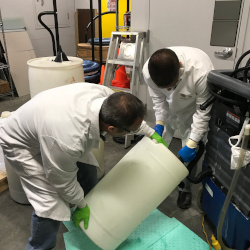
How Exposures Occur Formaldehyde is an irritant and sensitizer by inhalation and skin contact. Individuals can become exposed to formaldehyde by contact to solutions and contaminated surfaces; handling of preserved specimens or cadavers; inhalation of solutions or materials (off-gassing formaldehyde) that contains, or is contaminated with formaldehyde (including clothing, shoes, and equipment); and through splashes to skin and eyes.
Poor sanitation measures may result in ingestion. Means of ingestion can be direct or associated with secondary means such contamination of hands, eating utensils, etc. Drinking formaldehyde solutions can cause severe burns to the throat and stomach. Ingestion of 30 milliliters (about 2 tablespoons) can cause death.
Preventing Exposure
University labs are well ventilated, but area ventilation may not be enough depending on the nature of the work and concentration of solutions. Work within a fume hood whenever possible, especially when:
¨ mixing or transferring solutions,
¨ working with high concentrations or large volumes in open containers,
¨ aerosolizing solutions,
¨ heating solutions, or
¨ spreading solutions over large surface area.
Also Important:
· Wear appropriate gloves (Nitrile or latex disposal for dilute solutions and where hands are not submerged in liquid. For higher concentrations Butyl or second non-disposable outer glove Nitrile glove is recommended. Always check the glove manufacturer recommended use chart.)
· Wash hands after handling, whenever you leave the lab, and always before eating.
· Don’t wear PPE (gloves, scrubs, lab coat) outside of the lab/work area.
· Keep contaminated clothing in Ziploc bags and launder separately.
· Keep solutions and contaminated media in closed containers.
Some areas or activities may require the use of a respirator.
If you have questions about the appropriate control measures, contact Environmental Health and Safety (EHS). For additional information, contact EHS and ask to speak to an Industrial Hygiene representative (303-724-0345).
Signs and Labels
The following wording is placed on containers of formaldehyde solutions:
Formaldehyde
CAUTION:
Respiratory Sensitization
Cancer Hazard
May Cause Eye Damage
Signage at entrances to areas where formaldehyde solutions are used in larger quantities or concentrations, or depending on the nature and extent of activity and storage:
DANGER
FORMALDEHYDE
IRRITANT AND CANCER HAZARD
AUTHORIZED PERSONNEL ONLY
Exposure Levels
The permissible occupational exposure limit for formaldehyde is 0.75 parts per million (ppm) as an 8 hour time weighted average. You are required to be enrolled in an occupational surveillance program if you have a potential exposure at or above 0.5 ppm. Serious acute affects begin for some at 10 ppm. Levels that are immediately dangerous to life or health (IDLH) begin at 100 ppm according the Occupational Safety and Health Administration (OSHA), while the National Institutes of Occupational Safety and Health considers 20 ppm IDLH.
The University EHS industrial hygiene staff conducts sampling and/or risk assessments to determine your exposure level.